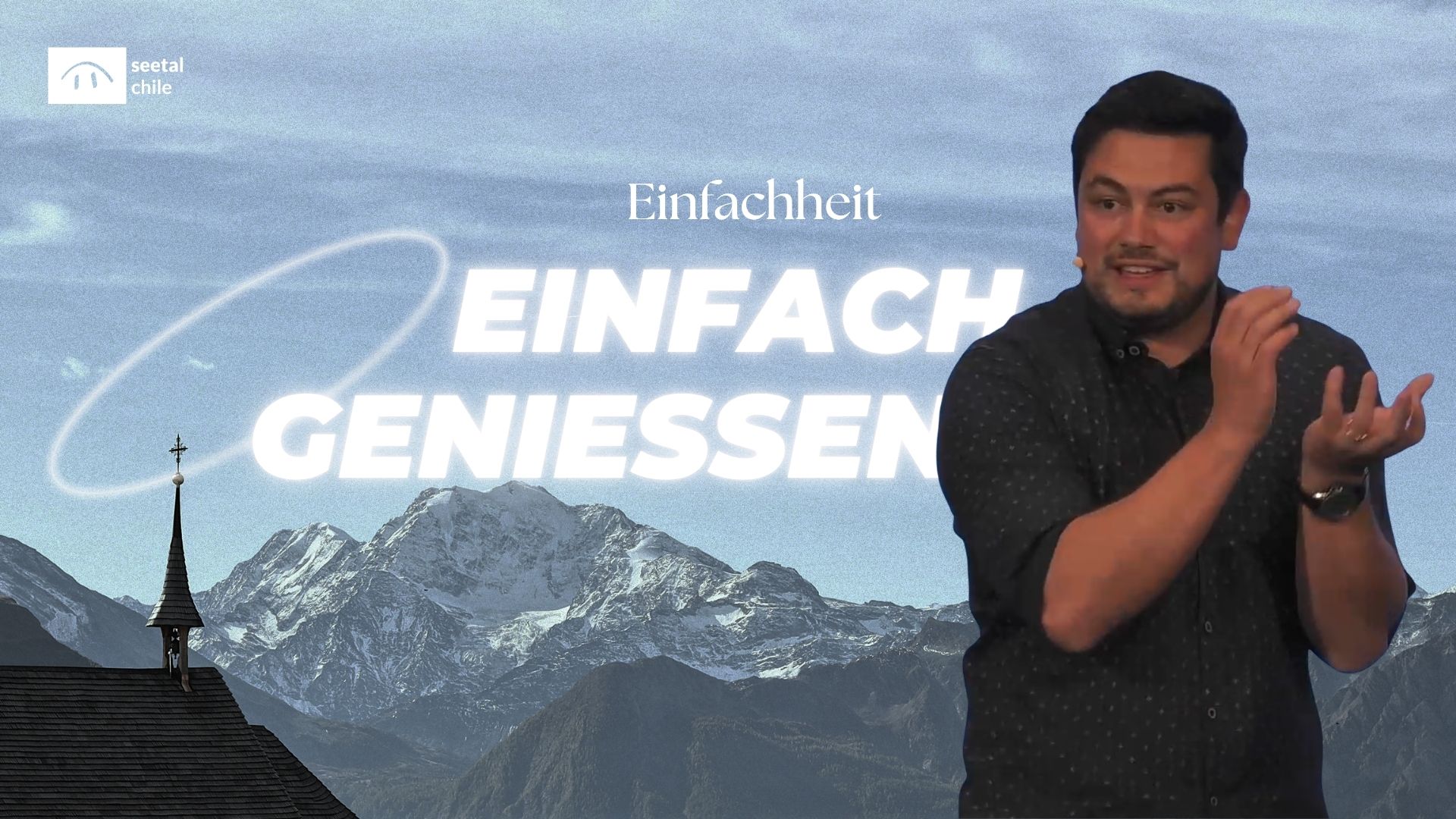
The Habits of Jesus | Living Simply
Series: Simple. Quiet. Present. | Bible text: 1 Timothy 6:6–10, 17–19
Jesus lived simply because his security lay not in possessions but in the Father. In a culture of ‘always more’, he invites us to let go of the ballast and learn contentment. It is not wealth that is the problem, but a heart that is attached to it. Those who let God be enough are freed from the pursuit of more and set free to be generous. Christian simplicity does not mean deprivation, but trust, freedom and more room for God.
When my son and I completed the first five stages of the Jura Cycle Route last year, we had to carry everything on our backs. So we scrutinised every item. Do we really need it? Can we do without it? Is there anything that serves the same purpose but is lighter?
For the first few kilometres, it made little difference. But on the gruelling stretches, every gramme made itself felt. I particularly remember the climb from St-Ursanne to Saignelégier through knee-deep mud. There, we were grateful for every gramme we’d saved.
It was then that I realised something: not only on a bike ride, but also in our spiritual lives, we often carry more with us than is necessary.
The Saturday before last, we cleared out the seetal chile basement. We were able to get rid of a lot of stuff. Suddenly, there was space. We could move about freely again. It was a pleasure to go down into the basement once more.
To me, it seems a bit like a parable. Jesus invites us to let go of the things that weigh us down. Not just material possessions, but also worries, fears, hurts, false securities and habits that take up space in our hearts.
For we are travellers. «For this world is not our home; we await our future city only in heaven» (Hebrews 13:14 NLB). When travelling, one should not carry more than is necessary.
Jesus himself lived that way. Although the whole of creation belonged to him, he lived a remarkably simple life. His security did not lie in his possessions, but in the Father. His freedom did not lie in having a great deal, but in having enough of God.
What can we learn from Jesus about the practice of simplicity?
Why more is never enough
«For the love of money is the root of all kinds of evil; and some people, in their greed, have strayed from the faith and brought great suffering upon themselves» (1 Timothy 6:10 NLB).
We live in a culture of ‘always more’: more success, more possessions, more achievement, more speed. Our entire economy is driven by growth. Our personal consumption habits are also constantly on the rise.
When I was a teenager, I had a rain jacket that I used as a ski jacket, a rain jacket or a windbreaker when cycling. My two pairs of jeans also served me well for everyday wear as well as for winter sports. Nowadays, I have separate clothes for every season and for different activities. This year I’ve even bought myself a pair of hiking trousers, something I’d successfully resisted for a long time.
130 years ago, the average household contained around 400 items. Today, that figure stands at around 10,000. These items need to be bought, looked after, insured, organised and, eventually, disposed of. More possessions often mean more effort and more worries.
«People who want to become rich are only tempted and become entangled in so many foolish and harmful desires that they ultimately bring ruin upon themselves and meet their own downfall» (1 Timothy 6:9 NLB).
Possessions promise security, status and happiness. Yet desires often multiply faster than possessions. No sooner has one goal been achieved than the next one is already waiting. That is how our culture thrives on ‘even more’: newer, bigger, faster, more modern.
The problem isn’t wealth. The Bible does not condemn the possession of property. The danger arises when our hearts begin to cling to our possessions and look to them for security and a sense of identity.
Heavy luggage is a strain. That applies just as much to a cycle tour as it does to life.
The secret of contentment
«True faith and the ability to be content with little are indeed great riches. After all, we brought nothing into the world with us when we were born and we can’t take anything with us when we die. That is why we want to be content as long as we have enough food and clothing» (1 Timothy 6:6–8 NLB).
«[…] let me be neither poor nor rich, but give me just enough to get by. For if I become rich, I might deny you and say, ‘Who is the Lord?’ And if I am too poor, I might steal and thus bring God’s holy name into disrepute» (Proverbs 30:8ff NLB).
Both texts describe the same spiritual attitude. Neither wealth nor poverty is the real goal. The goal is a heart that trusts in God. The author of Proverbs asks for the right balance. He knows that both excess and want can harbour spiritual dangers. That is why he asks for what he really needs.
Frugality does not mean owning very little. Contentment means that God is enough. We find this insight time and again in the history of the Church.
Francis of Assisi was born the son of a wealthy cloth merchant. After his conversion, he realised how strongly his heart was bound by his possessions. The crucial point is not his poverty in itself, but his realisation: What I own must not define who I am. Franz wanted to have less so that he could be freer to serve God and others.
The Puritans of the 16th and 17th centuries took a different path. Many of them were successful merchants or entrepreneurs. Yet they, too, asked: Do I really need this? Does this possession serve God? Does this luxury make me more grateful or more dependent? The Puritan Richard Baxter wrote, in essence, that Christians should make use of the world without setting their hearts on it. For the Puritans, the guiding principles were: to work hard, to manage their affairs responsibly, to give generously and to live modestly.
Jesus Christ, the Son of God and heir to all creation, lived out this attitude to perfection. On one occasion, he replied to a scribe who wished to follow him: «Foxes have their den and birds have their nests, but the Son of Man has no place to lie down in» (Matthew 8:20 NLB).
Jesus did not live in want, but in trust. His security did not lie in what he owned, but in his father. That is why he was able to live a simple life.
Paul is not talking about a mindset of scarcity, but about freedom: having to own less, having to prove less, having to worry less.
Simplicity means living a life of gratitude, mindfulness and contentment. For possessions are excellent servants, but poor masters.
Being rich in God’s way
The aim of Christian simplicity is not renunciation. The aim of Christian simplicity is love.
«Tell all those who are rich in this present world not to be proud and not to put their trust in their money, which will soon pass away. Instead, they should place their trust in the living God, who gives us everything we need in abundance, so that we may rejoice in it and enjoy it. Urge them to use their money to do good. They should be rich in good deeds, generously supporting those in need and always ready to share with others what God has given them. In this way, they lay a good foundation for the future with their possessions, so that they may lay hold of true life» (1 Timothy 6:17–19 NLB).
Paul does not urge the rich to give everything away. He urges them to use their possessions as instruments of God. Simplicity therefore leads to generosity, to time for others, to trust in God and to open hands.
Christianity does not end in minimalism. The aim is not to own as little as possible, but to become as free as possible for God. The crucial question is not: «How much can I have?», but: «What does my heart actually hold?»
Christian simplicity is not a loss of life, but a liberation from unnecessary burdens. Those who find fulfilment in Christ do not need to possess everything. When Christ becomes our greatest treasure, many other things lose their exaggerated importance.
One of the most beautiful things about the Good News is that Jesus defines who we are and gives us immeasurable worth. We have been bought at a high price. It cost Jesus his life. Those who understand this new identity gain a deep sense of freedom in how they view possessions and status.
Three practical ideas for practising a frugal lifestyle:
- Avoid making an unnecessary purchase.
- Give a thoughtful gift.
- Give thanks to God every day for what you already have.
These are small steps. Yet Christian simplicity often begins precisely there: not with a radical upheaval, but with a changed heart and many small decisions.
On our cycle tour, every gramme we shed was a relief. It’s much the same in our spiritual life. Perhaps today Jesus is inviting someone to let go of something they don’t need. Perhaps a worry. Perhaps a hurt. Perhaps the pressure to always have, achieve or appear to be more.
Christian simplicity does not begin in the basement, nor in the wardrobe, nor in the bank account. It begins in the heart. It begins where Christ becomes our greatest treasure. Those who find fulfilment in Christ do not need to possess everything else. Those who have found their identity in Christ do not need to prove their worth through possessions. Those who are held by Christ can travel light.
For the aim of Christian simplicity is not self-denial, but freedom. Not deprivation, but trust. Not a lesser life, but more room for God.
Possible questions for the small group
Read the Bible passage: 1 Timothy 6:6–10, 17–19
- Where do you feel the pressure to ‘always have more’ most strongly in your everyday life? In which areas do you find it hard to be content with what you already have?
- What «baggage» are you currently carrying around with you? Don’t just think about possessions, but also about worries, obligations, expectations or hurt feelings.
- What does the phrase ‘Contentment means that God is enough’ mean to you personally? In what ways does this thought challenge you, and in what ways does it encourage you?
- Jesus did not live in want, but in trust. In which area of your life might God be inviting you to trust him more, rather than relying on your own sense of security?
- What specific step could you take in the coming week to start living a simpler, more carefree life? For example: going without an unnecessary purchase, giving something away, spending time with people, or consciously thanking God for what we already have.