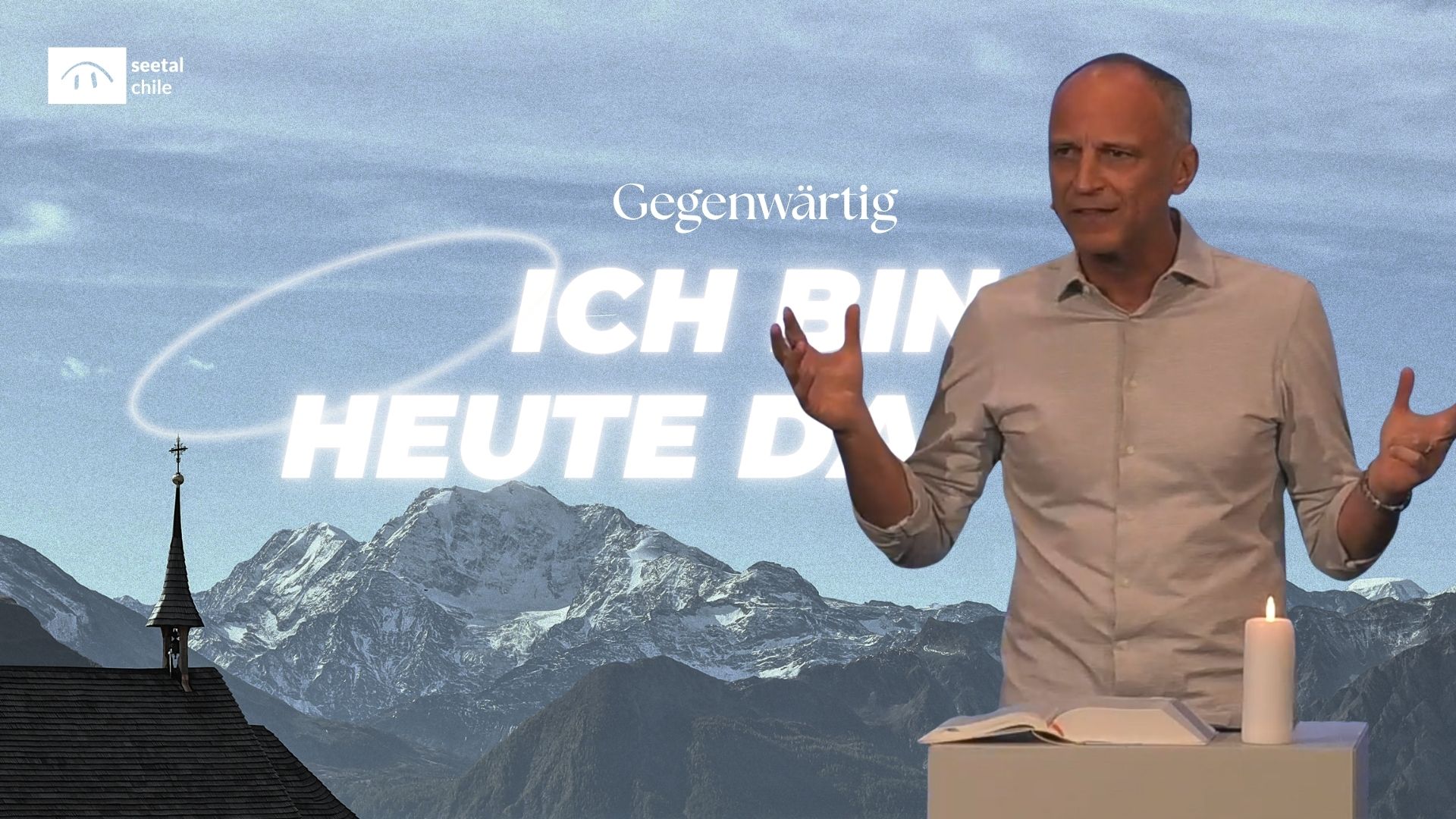
At present | God is here
Series: Simple. Quiet. Present. | Bible text: Exodus 3:1–14
God is present – even when we do not perceive his presence. At the burning bush, Moses realises that God sees the suffering of his people, hears their cries and knows their pain. In our everyday lives, too, «bushes» can draw our attention to God’s presence. And God’s name, «I Am», reminds us: we do not know what tomorrow will bring. But we can be certain of who will be there tomorrow. God is there.
Our theme for the year is: Simple. Quiet. In the moment. Today we’ll start with the third word: ‘Gegenwärtig’. What does it mean to live in the present? Perhaps the first thing that springs to mind is mindfulness: living in the moment, rather than constantly dwelling on yesterday or tomorrow. That is not wrong. But the Bible goes even deeper than that. For before we talk about how we can live in the present, we must talk about God’s presence. The message of Exodus 3 is: God is here.
God is here – even if we cannot see him
For almost four hundred years, Israel had to live with an experience that felt like God’s absence. The descendants of Abraham had become a great nation. God had made promises to Abraham. His descendants were to become a great nation and possess the land of Canaan. And now? Slavery in Egypt. People were forced to work. They were oppressed. They suffered. How does that all fit together?
Perhaps they asked themselves: Where is our God? Perhaps the story of Abraham had become a distant memory. Perhaps some even doubted whether these promises still held true at all. And then Moses comes along. He is now living in Midian. He tends sheep. An unremarkable life. Yet one day he sees a thorn bush that is on fire but is not being consumed. Moses stops. And there he encounters God. But before God gives Moses his mission, He says something that touches me deeply: «I have seen how my people are being oppressed in Egypt. And I have heard their cries. I know how much they are suffering» (Exodus 3:7 NLB).
Three things: I have seen. I have heard. I know their pain.
Israel may have thought: God does not see us. God says: I have seen. Israel thought: God does not hear us. God says: I have heard. Israel thought: God has no idea how we are feeling. God says: I know your pain.
That is God’s presence. God is not simply up there somewhere. He is not a detached observer of our history. He sees. He hears. He knows.
And then God even says: «I have come to rescue them from the power of the Egyptians and to lead them out of Egypt into a beautiful, spacious land, a land flowing with milk and honey […]» (Exodus 3:8 NLB). God does not keep His distance. His presence becomes an active presence. Perhaps there are some amongst us who are asking themselves right now: «’God, can you even see me?» «Can you hear my prayer?» «Do you know how I’m really feeling?»
So this passage does not say that we will always understand what God is doing. But it does say: You are not invisible to God. Your prayer is not unheard. Your pain is not unknown to God. Israel is experiencing God’s absence. But God says: ‘I have seen you. I have heard you.’. I know how you feel. God was there, even when they couldn’t sense his presence.
God is here – watch out for thorn bushes along the way
And then God does not meet Moses in a temple. Moses is not attending a service. He is at work. He is tending sheep. And in the midst of this ordinary everyday life, he sees a burning bush that is on fire yet is not consumed. Moses could simply have carried on. But he stops. The phenomenon of a bush catching fire was well known. What was remarkable was that the bush did not burn up. That is why Moses stops. «’That’s odd,’ he said to himself. ‘Why isn’t this bush burning? I’ll have to have a closer look at that.’» (Exodus 3:3 NLB).
Perhaps this holds an invitation for us: God is present in the midst of our everyday lives. That is why I would like to leave you with a thought today: Watch out for the thorny bushes along your path. Not every thorn bush is a burning thorn bush. And certainly not every thorn bush burns without being consumed by the flames. But every thorn bush can be a reason to take notice.
- Perhaps your thorn bush is a strange coincidence.
- Perhaps someone you meet at exactly the right moment.
- Perhaps a sentence that takes you by surprise.
- Perhaps a burning sensation in the stomach, a sense of inner restlessness or a longing.
- Perhaps a sunrise that makes you suddenly think: ‘How beautiful this world is!’
- Or perhaps a Bible verse that you’ve read a hundred times and which suddenly speaks to you today.
Is all of this automatically God speaking? No. Not every coincidence is a sign. Not every gut feeling is God’s voice. But perhaps we are sometimes so busy that we no longer even notice when something deserves our attention. Moses stops. He looks. And there, God meets him. Our attention does not make God present. It makes us present to God.
Perhaps this would be a good exercise for this week: pay attention to the thorn bushes in your path. If something makes you pause, don’t carry on straight away. Take a look. Be still. And ask: «God, are you here? Do you want to show me something?»
Perhaps nothing out of the ordinary will happen. But perhaps you’ll discover something you would otherwise have overlooked. For sometimes, sacred ground can be found right in the midst of our ordinary everyday lives.
God is here – even in our questions
God gives Moses a mission: he is to return to Egypt and lead the people of Israel out of slavery. But Moses has questions. One of them is: «If I go to the Israelites and say to them, ‘The God of your forefathers has sent me to you’, and they then ask me, ‘What is his name?’, what am I to say to them?» (Exodus 3:13 NLB).
In fact, Moses asks: «Who are you, God?’ And God’s answer is awe-inspiring: ‘I am who I always am. Just tell them: ‘I am’ sent me to you» (Exodus 3:14 NLB). «I am who I always am.» In Hebrew: Ehjeh. This sentence can also be interpreted in a more dynamic way: «I will be who I will be.» Or: «I shall prove myself to be the person I am destined to be.» And immediately afterwards, in verse 15, God reveals his name: YHWH, Yahweh. Linguistically, both words are related to the Hebrew verb ‘to be’. God is the One who is – who is there – and who will prove Himself to be who He is.
So God does not simply give Moses a definition. He says: I am. I am here. I was here. I will be here. It is precisely this statement that we also find in the Book of Revelation: «‘I am the Alpha and the Omega – the beginning and the end,’ says the Lord and God, ‘who is, who always was, and who is to come, the Almighty’» (Revelation 1:8 NLB).
Moses does not yet know what awaits him in Egypt. The Israelites do not yet know what their liberation will look like. And we, too, do not know what tomorrow will bring. But we know who’ll be there tomorrow.
We ask God lots of questions: «Can you see me?» «Do you know me?» «Will you help me?» «Will you forgive me?» «Are you still there?»And God does not answer every one of our questions in the way we would like Him to.’. But here He gives Moses something that goes deeper than an explanation: He gives him Himself. I AM.
And now it gets interesting: these words resound once more in the New Testament. In the Gospel of John, Jesus says «I am» a total of seven times: «I am the bread of life» (John 6:48 NLB). «I am the light of day» (John 8:12 NLB). «I am The Good Shepherd» (John 10:11 NLB), etc. The God who appeared to Moses at the burning bush is not a God of the past. The ‘I AM’ is present in Jesus Christ. That is the crux of the Christian faith: God does not remain at a distance from our world. He does not merely say: «I can see your suffering.» He is coming. He will become human. He will become one of us. If we want to know what God is like, we look to Jesus. There we see the God who sees. The God who hears. The God who shows mercy. The God who meets people. And the God who saves. On the cross, this presence of God becomes visible in a special way. There, Jesus bears our guilt and sin. He bears our estrangement from God. For this, He even goes to His death.
And it is precisely there that we see: God is there for us. Not just: God is there. But: God is there for you. Perhaps there is a situation in your life too where you feel as though God has forgotten you. Perhaps you have been waiting for a long time. Perhaps you have been praying for a long time. Perhaps you do not understand why God allows certain things to happen. In that case, this story does not say: «You just need to look a bit more closely, and then you’ll feel God’s presence.»
The message runs deeper: God is here – even if you cannot sense his presence at the moment. And as Christians, we can go one step further: We know where we see God’s presence most clearly: in Jesus Christ. He is Immanuel. God with us. You may not know what tomorrow will bring. You do not know what challenges lie ahead. You do not know which doors will open or close. But: You may know who will be there tomorrow. Jesus Christ. So: Stop every now and then. Take note of the thorn bushes along your path. Look closely. Be still. And then, in the midst of our ordinary daily lives, we discover something that Moses discovered back then: we are not alone. God is there.
Possible questions for the small group
Read the Bible passage: Exodus 3:1–14
- In what situation are you currently finding yourself where you ask yourself: «God, can you even see me? Can you hear my prayer?» What might it mean to trust that God is present all the same?
- What «thorn bushes» are currently in your path? Is there anything that makes you pause, touches you, preoccupies you or keeps drawing your attention?
- What might help you to become more aware of God’s presence in your daily life? Is there a specific habit you’d like to try out over the coming week?
- «I am – I will be.» How does this idea change the way you view a situation where you don’t yet know how it will turn out?
- Where, specifically, would you like to experience God’s presence over the coming week? What would be a small step where you could say: «God, I am not walking this path alone»?