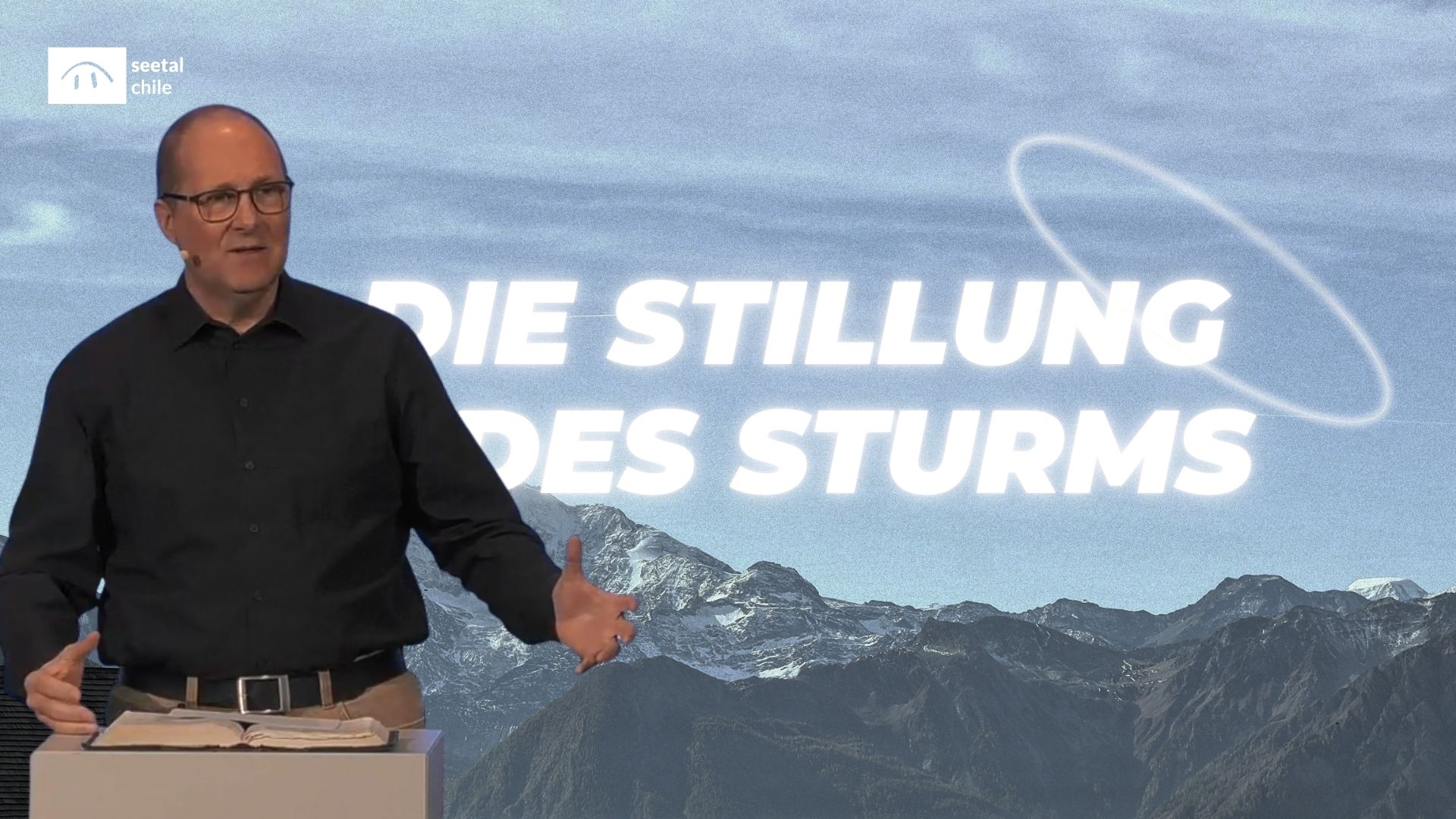
Habits of Jesus | Slowing down
Series: Simple. Quiet. Present. | Bible text: Matthew 11:25–30
A decelerated lifestyle helps us to find true inner peace, grow spiritually and lead a life characterised by love and divine fruit. Jesus himself did not live a driven life, but took time for his Father and for people – even in seemingly urgent situations. His habits serve as a guide and «climbing aid». Slowing down does not happen by chance, but through consciously practised decisions and structures in everyday life. This creates space for God’s work and for genuine encounters.
Bernese people are not necessarily known for being the fastest. I lived in the city of Bern for four years and therefore spent a lot of time in the old town with its covered arcades. This is a brilliant thing when it rains, because you stay dry. But it’s also quite a hassle during shop opening hours if you want to do something quickly. That’s why I’ve developed a tactic: run fast, overtake on the left and right, leave the pergola briefly if you have to. The main thing is to move quickly. That’s me! And today I’m preaching about slowing down.
It is the start of a four-part sermon series on the «Habits of Jesus». The structure of the titles is based on John Mark Comer’s book «The End of Restlessness». Some of his thoughts and those of others who have dealt with this topic have also been incorporated into this sermon. Today it is about the introduction and the question of why we should orientate ourselves on the habits of Jesus and not just on his words. We start with slowing down, followed by silence and solitude, Sabbath and living simply. Our theme for the year is «Simple. Quiet. Present.» – which is exactly what this series is about.
Jesus» gentle yoke
«Then Jesus said, «Come to me, all you who are weary and carry heavy burdens, and I will give you rest. Take my yoke upon you. I will teach you, for I am humble and gentle, and your soul will rest with me. For my yoke fits you perfectly, and the burden I lay on you is light» (Matthew 11:28–30 NLB). It’s about taking Jesus» yoke upon yourself in order to learn from him. He wants to give rest to those for whom religion is a duty. For all those who cannot harmonise their will with that of God. We stand in the tradition of Huldrych Zwingli, the great Swiss reformer. That is why we are also in danger of overthinking our faith. But we also see in the Lord’s Supper, for example, that Jesus gave his body! We can now experience this in our own bodies by partaking of bread and grape juice. It is about me as a whole person. This includes my mind, but also my body! It is about learning from Jesus – from his habits, from his life.
A yoke was and is an instrument of labour that was imposed on the oxen in the field so that they could do their work. A yoke is something that weary labourers actually need the least. But the best gift Jesus can give people is a new yoke – a new way of living life. Jesus offers us an invitation to a life of rest despite all the burdens that come our way every day. In Jesus» time, the word «yoke» was also used to describe the law of God. Jesus» invitation is an invitation to follow him. It is a life of meekness and humility. Meekness means kindness, consideration, patience and composure – without anger and violence. Humility means a love of service and modesty. It is about an inner attitude that manifests itself in this way. Following Jesus is shown by the fruits that arise from it. But how do we get there?
Jesus goes through life at a slower pace
A vine grows in the garden next to our flat. The first year, I simply cut it back because it was annoying me, it was in the way and nothing really grew. The following year, my father, who had always worked in a vineyard in Vaud during the summer holidays as a teenager, made a climbing aid. He stretched wires along the wall and attached the vine to them. The result was lots of delicious grapes. So delicious that we have to defend them against wasps. The aim is to bear fruit. The climbing aid is necessary for this, but it’s not about them. My father learnt from professionals how to do this – so we want to learn from professionals too! Jesus» habits are just that: climbing aids for our faith. They may seem to have nothing to do with faith at first glance. But they must never become an end in themselves. How do I recognise when something becomes an end in itself? By the lack of fruit. But what fruit should we bear? It’s about the ability to love. This manifests itself in many ways, but fundamentally in the fruit of the Holy Spirit: «If, on the other hand, the Holy Spirit rules our lives, he will cause completely different fruit to grow in us: Love, joy, peace, patience, kindness, goodness, faithfulness, gentleness and self-control. […]» (Galatians 5:22–23 NLB).
Dallas Willard speaks of habits as spiritual exercises. He says: «Spiritual exercises are things we do to bring ourselves and all aspects of our being into harmony with God’s order. They enable us to live more and more out of a power that has its origin in the spiritual world and that far exceeds our own strength» (Dallas Willard). The goal is to build a good trellis that will support my faith and bear fruit. However, it is not about the climbing support, but about the fruit. However, the climbing support is indispensable.
In Jesus» life, disruptions take priority. Many encounters happened «on the way» or while he was actually doing something important. I would like to emphasise two in particular. Firstly, the story between Jesus and Lazarus (John 11). There were three siblings: Mary, Martha and Lazarus. They were good friends. «Jesus loved Martha, Mary and Lazarus» (John 11:5 NLB). One day Jesus receives the news of Lazarus» illness. But before he leaves, he stays where he is for two more days. Jesus lived a very slow life and did not allow himself to be rushed. Lazarus eventually died. (Yes, Jesus then brought him back to life).
The second encounter is that of the woman with the issue of blood (Mark 5:21–43). An important man named Jaïrus comes to Jesus and asks him to heal his dying daughter. Jesus went with him. He allowed himself to be interrupted. On the way, a woman who had been suffering from haemorrhages for 12 years mingles with the crowd. «This woman had heard about Jesus. She fought her way through the crowd to get close to him and touched the hem of his robe» (Mark 5:27 NLB). What happens now? The woman is healed and Jesus stops. He allows himself to be interrupted again. Here it comes: «While Jesus was still talking to her, messengers arrived from the house of Jairus with the news: «Your daughter is dead. You no longer need to trouble the teacher» » (Mark 5:35 NLB). What was going on in Jairus? (Yes, Jesus brought them to life too).
Here you might think to yourself: «Sure, Jesus is God and therefore everything is possible for him. But not me, so I have to go straight away and I can’t be interrupted.» Yes, that’s true – but very few of us are in such situations. I often don’t even manage to allow myself to be interrupted by parents, spouses, good friends, children or work colleagues and have time for them. With too busy a schedule, we don’t have time for interruptions. What’s more, time with God often falls by the wayside.
Decelerated living
The difficulty is that we live in a different time. It is much more fast-paced than in Jesus» time. But we can always ask ourselves the question: «How would Jesus live if he were me?» The tendency is for time with God to be fought over. If you don’t plan, you’ll be planned for. If you are always stressed, you will not enter into rest with God. This influences each other. I can’t just say: «From now on I’ll be more relaxed, less stressed and want to be more in the here and now», and that happens. I can’t force this to happen. But I can practise habits (climbing aids), plan for them and make them a rule for myself that produce this fruit.
I am happy to pass on the «rules» that I follow. These are not rigid and it’s not a bad thing if I don’t stick to them. But they help me to structure my life. Some people don’t like structure. I am convinced that we all need more or less structure. I’m a steady person and structures help me. They don’t restrict me, they set me free. If we desire to become more like Jesus, but this is not reflected in our schedule, desires and plans, then it won’t happen! They help me to discover and practically apply what the psalmist says in my relationship with Jesus: «Taste and see how kind the Lord is. Blessed is he who trusts in him!» (Psalm 34:9 LUT). These habits help me. Yours look different! Not a law, but climbing aids.
- I switch off my mobile phone on my day off and reduce my consumption to a minimum during the holidays.
- I consistently keep to the speed limit.
- I only meet up with one friend a week, but I make a lot of time for this person.
- In a traffic jam, I decide in favour of one lane and stay there!
- I reduce «Glust purchases» to a minimum.
- I have an analogue alarm clock and switch off my mobile phone in the evening.
- I don’t buy things that cost more than CHF 100 without sleeping on it once and discussing it with my wife.
- Once a week I fast for two meals.
- Agreed appointments will not be postponed in favour of a «better» option.
- And: Since this week I’ve been trying to run more slowly ;-)
Jesus lived in a different time, but he still lived in the moment and we never read that he was stressed or rushed. Nor did he allow himself to be stressed or rushed by others. At first glance, slowing down is the least «spiritual» habit we are talking about in this series. But it’s about living your body and faith in harmony. I don’t just have a body and a mind – I am body and mind. Slowing down means creating space for encounters with God. I’ll end with a prayer that a person from church gave me some time ago: «Lord, show my heart what is important to your heart».
Possible questions for the small group
Read the Bible text: Matthew 11:25–30
- Where do you feel most restless or driven in your everyday life? What specifically drives you there – external circumstances or inner expectations?
- «Come to me, all of you … I will give you rest» (Matthew 11:28). How do you practically experience this invitation from Jesus in your life – and where do you find it difficult to accept it?
- The picture of the yoke: Which «yokes» are you currently wearing (consciously or unconsciously)? How do you recognise whether it is Jesus» yoke – or a self-made one?
- Habits as «climbing aids»: Which of your current habits promote spiritual fruit – and which ones tend to get in the way? Where do you feel that something has become an end in itself?
- Dealing with interruptions: How do you usually react when your plan is disrupted? What could change if you saw interruptions more as possible «divine moments»?
- Time with God in everyday life: If «if you don’t plan, you’ll end up planning» is true – how specifically are you currently planning your time with God? What would be a realistic next step for you?
- Fruit of the Holy Spirit (Galatians 5:22–23): Which of these fruits are you visibly growing at the moment? Where do you wish for change – and what small «climbing aid» could you practise for this?