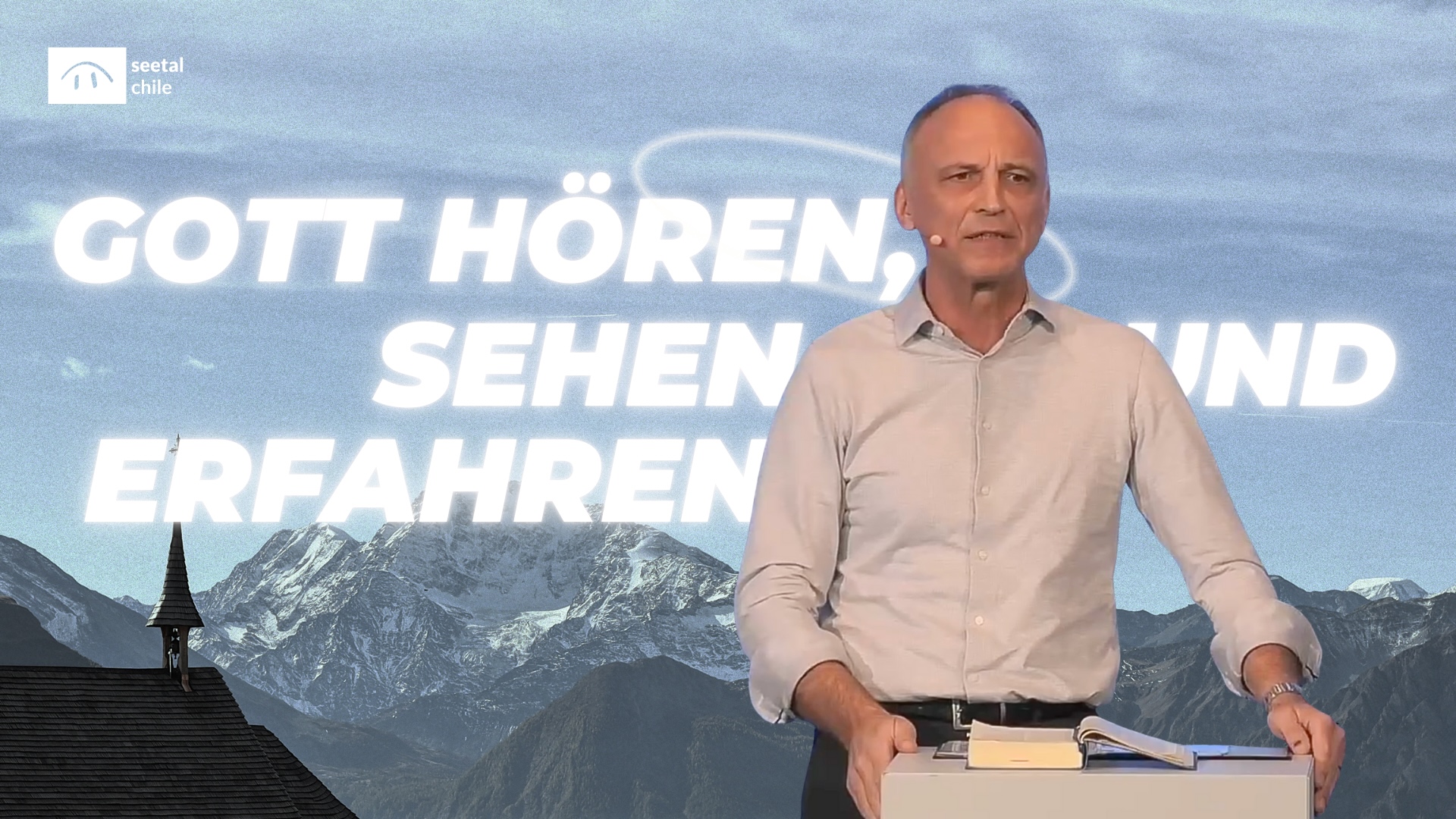
Hear, see and experience God
Series: Simple. Quiet. Present. | Bible text: Psalm 46:11
The sermon invites us to become quiet in the midst of noise, performance and inner turmoil in order to hear God’s quiet words anew. Based on the biblical desert, it shows that solitude and silence are places of purification, of finding one’s identity and of encountering God. Those who create space for silence recognise God more deeply, are transformed inwardly and gain compassion and spiritual clarity for a fruitful ministry.
Two people are walking together through a busy street. The noise of engines hangs in the air, voices overlap, footsteps echo on the pavement. Suddenly, one of them stops and says quietly: «Do you hear that?» The other also stops, listens – and shakes his head. «I hear cars, buses, voices. Nothing more.» «I hear a cricket chirping nearby», says the first.
The friend walks a few steps further in disbelief. But sure enough – a small cricket is sitting between the leaves on the wall of a house. Its chirping was there the whole time. Not loud. But audible – for those who pay attention. The friend is amazed: «You must hear better than I do.» The answer is simple: «No. I’ve just learnt to be quiet and pay attention to what’s quiet.»
Then the man drops a coin on the ground. A brief clink – and immediately people in the neighbourhood turn round. The sound was barely louder than the chirping of a cricket. And yet it was heard. Why? Not because it was louder. But because we are attuned to it.
This little incident leads us to a crucial question: what do we hear – and what do we ignore? Because God also speaks. Not always in the storm. Not always in an earthquake. Not always in the fire. That is why God himself says: «Be still and recognise that I am God!» (Psalm 46:11 LUT).
The seetal chile’s theme for 2026 is: Simple. Quiet. Present. Where we become silent, God becomes audible. Where we simplify, God becomes visible. Where we live presently, God becomes tangible.
«Our» sounds
Psalm 46 is not a quiet psalm. It speaks of earthquakes, raging waters, tottering empires and wars. In the midst of this chaos, God speaks: «Be silent.» The Hebrew word means more than silence. It means: to let go, to stop, to come to rest. Not because everything is resolved, but so that God can be recognised. Silence is not the goal. Recognising God is the goal.
We live in turbulent times. Our days are full, our weeks are planned, our years are filled with projects. We hardly ever stop to check whether what we are doing is really essential. Driven by «must» and «should», we follow guidelines as if they were the gospel itself. As soon as a moment of silence arises, we reach for our mobile phones and allow our attention to be occupied again.
The reason for this is deep: our identity is at stake. We make ourselves dependent on the perception of others. A false self emerges – fuelled by recognition and fear. Who I am seems to depend on how I am seen. And so fear and insecurity drive us to accumulate more and more: more achievement, more success, more affirmation.
Before Jesus began his public ministry, he was led by the Holy Spirit into the desert. There he was confronted with the three great temptations of the false self: to be relevant («Turn stones into loaves»), to be spectacular («Throw yourself down») and to be powerful («I will give you all these realms»). In solitude, Jesus affirmed God as the only source of his identity: «You shall worship the Lord your God and serve him alone» (Matthew 4:10 NLB).
Solitude is the place of the great struggle against the temptations of the false self – and the great encounter with the loving God who offers himself as the foundation of the new self.
Be quiet
When God wanted to make a leader out of Moses, he didn’t give him a stage – he gave him the desert. Elijah, John the Baptist and Jesus were also prepared for their ministry in the desert. The desert is a significant place in the Bible.
On our trip to Israel last November, we walked through the Judean desert. We were challenged to walk alone, to be quiet and to focus our thoughts on God. It was an extraordinarily deep spiritual experience.
The desert is a space without distraction, without certainties, without abundance. In it, God’s word becomes audible because everything else is silent. The Hebrew word for desert – midbar – is closely connected with dabarthe word. Moses encounters God in the burning bush in the desert (Exodus 3:1–6). God addresses him by name and calls him to the task of leading the people of Israel out of Egypt into the land of Canaan. The Bible knows no faith without times of silence.
The desert is also a place of purification. For Israel, it was the training ground between Egypt and the Promised Land, between bondage and freedom. There, what is in the heart is revealed: «And you shall remember all the way through which the LORD your God has led you these 40 years in the wilderness, to humble you, to test you, so that what is in your heart may be revealed […]» (Deuteronomy 8:2 SLT). The desert exposes our self-will, our pride, our false self. It is a mirror of the heart.
When I spent three months in Canada in 2023, it was a desert time for me. I was alone – for hours, days, weeks. In this loneliness, everything fell away: family, friends, conversations, tasks, stage. What remained was myself – naked, vulnerable, weak, sinful, empty. This emptiness was so painful that everything inside me wanted to flee: back to work, to distraction, to affirmation. The desert is the place of the great battle against the false self. It got to the point where I wondered how long I could stand it. But the moment I realised what was at stake in this fight, there was no turning back.
The desert is also the place of the great encounter with God. Where we no longer have anything to show for ourselves, God offers himself as the foundation of a new self. His personal approach becomes the source of our identity.
Moses once wanted to be judge and saviour in his own strength. «On the way, he saw an Egyptian mistreating an Israelite. Moses came to his aid, avenged him and slew the Egyptian […] But the man […] pushed Moses aside: «Who made you ruler and judge over us?» he asked» (Acts 7:24, 27 NLB). Moses acted in the heat of the moment, in his own name and out of his own strength. After 40 years of purification in the desert, Moses was a different man: «Moses was very humble, there was no one on earth more humble than him» (Numbers 12:3 NLB). This humility was evident in his compassion – and in the fact that he did not want to take another step without God’s presence (Exodus 33:3, 15–16).
When God wanted to prepare Joseph for the palace, he did not give him a quick route – he led him through the pit and the prison. Both were important deserts of transformation. In his younger years, Joseph had a proud and arrogant heart. His brothers became so angry that they sold him to passing merchants. After more than 20 years, Joseph sees his brothers again and could have used his position to take revenge. But he says: «So do not be afraid. I myself will take care of you and your families. So he reassured them and spoke to them kindly» (Genesis 50:21 NLB). A proud man has become a compassionate man.
Compassion is the fruit of solitude and the foundation of all service. The desert does not prepare us for retreat, but for a sacred service. The desert fathers said that solitude is the furnace of transformation.
Recognising God
«Be still and recognise that I am God!» (Psalm 46:11 LUT). The desert is not the goal, but a path of purification and preparation. The goal is the knowledge of God. This realisation is a relationship, not just knowledge. Recognising means perceiving the other person as a whole. The Bible promises a time when this realisation will permeate everything: «[…] for as the waters fill the sea, so the earth will be filled with the knowledge of the LORD» (Isaiah 11:9 NLB)
God is already inviting us into this depth of a heart relationship: «But now I will speak kindly to her. I will lead her into the desert and speak to her heart there» (Hosea 2:16 NLB). «I still remember the affection of your youth, your bridal love, when you followed me in the desert, in a land without seed» (Jeremiah 2:2 SLT).
We want to create space – in our hearts, in our everyday lives, in our church, so that God’s voice can be heard, his love can be felt and his guidance can be recognised. We are challenged to create our own desert in the midst of chaos, where we can retreat daily, shake off our constraints and dwell in the gentle, healing presence of our Lord.
This begins very concretely: reserving a time and place to be alone with God. The form will be different for everyone. But a spiritual discipline never remains vague. Mother Teresa once said: «Spend an hour a day worshipping your Lord and never do anything that you know is wrong, then all will be well.»
Simple. Quiet. Present. Where we become silent, God becomes audible. Where we simplify, God becomes visible. Where we live presently, God becomes tangible. And we will hear the crickets chirping in the noise of everyday life.
Possible questions for the small groups
Bible text: Psalm 46
- Which «noises» currently dominate my everyday life the most – and what could prevent you from perceiving God’s quiet speaking?
- Where do I consciously experience or avoid silence? What does silence trigger in me? Peace, restlessness, fear – and why might that be?
- The sermon speaks of the «false self». How do I personally recognise that I derive my identity from performance, recognition or control?
- What experiences of «desert times» have I had in my life? Were there moments when loneliness or deprivation changed me inwardly or when I encountered God anew?
- What could my «own desert» look like in my everyday life? What time, place or form of silence would be realistic for me – and what has prevented me from doing this so far?